
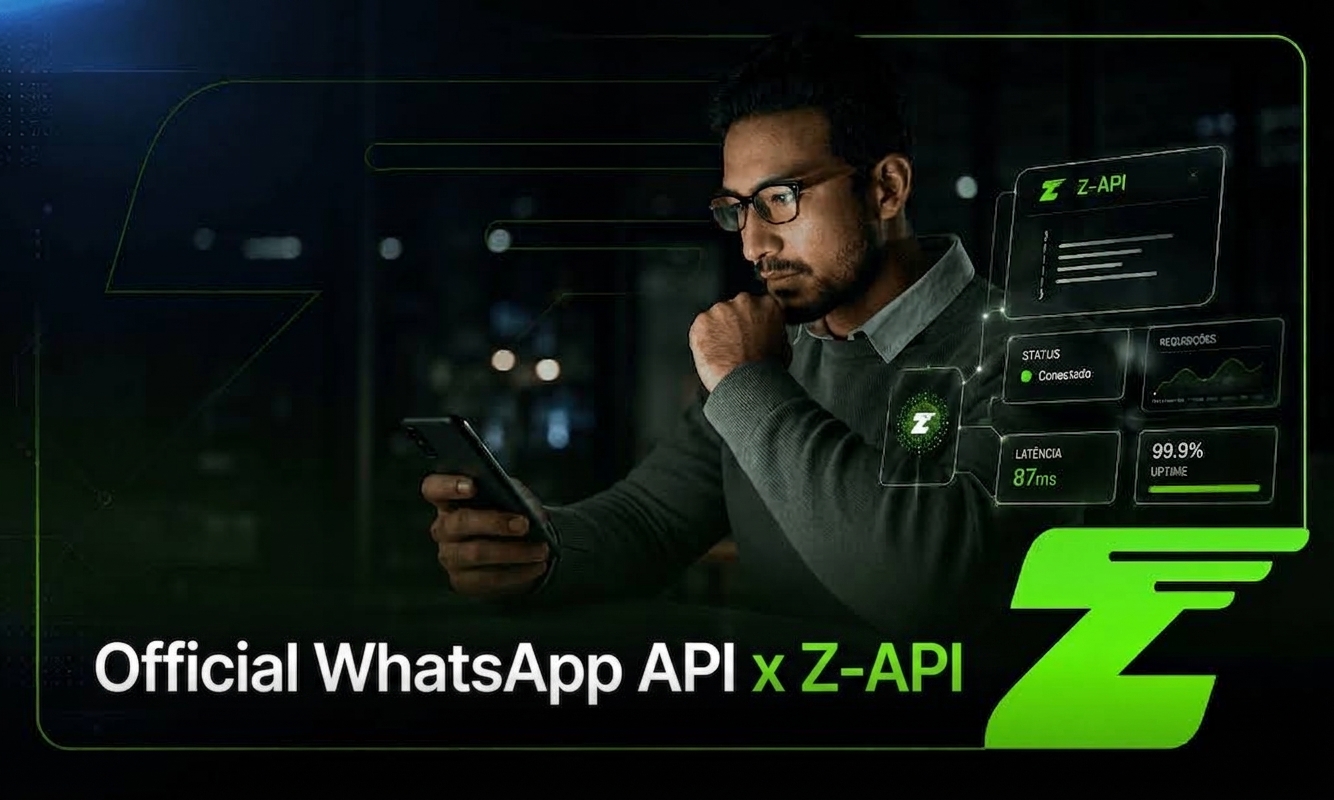
Official WhatsApp API vs. Z-API? Choosing an API to integrate WhatsApp with a system involves much more than comparing features.
For SaaS companies, software houses, automation agencies, and businesses that rely on WhatsApp as part of their products, this decision can affect costs, technical flexibility, implementation speed, scalability, and operational risk.
On one side is the WhatsApp Business Platform, Meta’s official API solution for business communication. It operates according to the rules, policies, and pricing models defined by Meta itself.
On the other side are independent APIs, which use different approaches to enable WhatsApp integrations and may offer greater implementation flexibility, while also requiring companies to carefully understand the risks and trade-offs involved.
This comparison has become even more relevant following Meta’s pricing changes. Since July 2025, the WhatsApp Business Platform has used per-message pricing across different categories, with additional changes already planned throughout 2026.
That means the question should not simply be: Which API is cheaper?
It should also be: Which model makes the most sense for my company’s architecture, risk tolerance, and growth strategy?
In this guide, we’ll compare the official WhatsApp API and Z-API based on criteria such as architecture, costs, rules, flexibility, and risks.
What is the Official WhatsApp API?
The WhatsApp Business Platform is Meta’s platform for enabling companies to integrate WhatsApp into their systems and use the channel for customer service, notifications, authentication, marketing, and other business workflows.
Within this ecosystem is the Cloud API, the API infrastructure hosted directly by Meta. WABA, meanwhile, stands for WhatsApp Business Account: the business account used to manage phone numbers and other assets related to the operation.
How does the Official API architecture work?
With the Cloud API, communication is processed through infrastructure hosted by Meta. As a result, the integration does not depend on keeping a physical smartphone connected in order to send and receive messages through the API.
To put a business number into operation, you need to register it for use with the Cloud API and verify ownership during the setup process.
Depending on the company’s structure, required limits, and features being used, additional business verification steps may also be required.
Companies can build the integration using resources provided directly by Meta or work with Solution Partners that add additional technology and service layers on top of the platform.
What is Z-API?
Z-API is a REST API that allows businesses to connect WhatsApp to external systems such as CRMs, ERPs, SaaS platforms, chatbots, and custom-built solutions.
Through API endpoints and webhooks, systems can perform actions on WhatsApp and receive events related to the connected account.
This architecture is especially suited to technology companies, SaaS businesses, software houses, agencies, and operations that need to turn WhatsApp into a feature integrated into their own products.
How does Z-API’s architecture work?
Z-API currently works with different types of instances.
With Web instances, the number is connected as a secondary device, in a way similar to WhatsApp Web. The connection can be established using a QR code or other connection flows available in Z-API.
Mobile instances, on the other hand, operate as the primary WhatsApp device. In this model, there is no need to keep a physical smartphone or emulator running as the account’s primary device.
This distinction matters because Z-API should not be understood simply as “WhatsApp Web automation.” Its architecture provides different connection options for different integration and operational needs.
More flexibility when building on WhatsApp
One of Z-API’s main differences lies in how developers can structure their integrations.
With the WhatsApp Business Platform, operations follow specific rules for messages, templates, categories, and customer service windows.
For example, when a user starts an interaction, it opens a 24-hour customer service window during which non-template messages can be sent. Outside the scenarios covered by that window, the platform’s specific template rules apply.
Z-API does not use the same template system for sending messages, which gives developers more freedom to create customized workflows. However, this does not eliminate the need to follow communication best practices or the risks associated with improper WhatsApp usage.
Official WhatsApp API vs. Z-API: a comparison by criteria
When choosing between the WhatsApp Business Platform and Z-API, it is worth looking at the criteria that have the greatest impact on a production environment: stability, flexibility, integration experience, and cost predictability.
Stability and architecture
Official WhatsApp API: the Cloud API is hosted on Meta’s own infrastructure and does not depend on a connected smartphone to operate. Meta states that the solution consistently delivers 99.9% uptime.
Z-API: uses its own instance-based architecture to connect systems to WhatsApp. The platform provides monitoring features, webhooks, message queues, and different connection options.
In 2026, Z-API also launched ConnectorZ, designed to provide an alternative connection method in situations where WhatsApp requires additional validation before allowing access to WhatsApp Web.
There is an important trade-off here: the Official API runs directly on Meta’s business infrastructure, while Z-API operates according to the architecture provided by its platform and the behavior associated with the connection method being used.
Features and flexibility
Official WhatsApp API: the WhatsApp Business Platform supports text, media, interactive elements, and other business messaging features. For company-initiated messages in certain scenarios, businesses use templates classified as Marketing, Utility, or Authentication, which go through Meta’s review process.
When users initiate or respond to a conversation, a 24-hour customer service window opens, during which businesses can send non-template service messages.
Z-API: does not use the same template system as the WhatsApp Business Platform. This gives developers greater flexibility to structure messages and automations around their own use cases.
The API supports features such as text, audio, images, video, documents, and other elements available through the integrated WhatsApp experience.
Z-API also provides an MCP Server, which allows MCP-compatible AI applications to connect to an instance and perform supported actions on WhatsApp. Current tools include message sending and group management, among other documented operations.
That flexibility does not mean best practices can be ignored: Z-API itself recommends avoiding spam, unwanted messages, and behaviors that are incompatible with WhatsApp policies.
Ease of integration and Developer Experience
Official WhatsApp API: the Cloud API provides APIs, webhooks, and other resources within Meta’s ecosystem. Integration requires businesses to configure business assets, access credentials, phone numbers, webhooks, and other components required by the application.
Z-API: was built around a straightforward developer experience using REST APIs and webhooks. The platform also provides technical documentation, Postman collections, and tools that allow developers to test endpoints even before building the full application.
According to the Z-API website, a new instance can be ready to send and receive messages in under 10 minutes, depending on the setup flow being used.
The financial impact: what changes in Meta’s pricing in October 2026
Cost is one of the areas where the two architectures differ most clearly.
With Z-API, pricing is based on instances, with a fixed monthly subscription and no per-message fee charged by the platform. The Ultimate plan is currently advertised at R$99.99 per month per instance.
The WhatsApp Business Platform, on the other hand, uses a pricing model based on delivered messages and their respective categories and conditions.
How does pricing work today?
Until September 30, 2026, service messages sent within the 24-hour customer service window remain free under the current pricing model.
Template messages, however, may be charged depending on their category, market, and other Meta pricing rules. The main categories are:
- Marketing: campaigns, offers, and promotional communications;
- Utility: updates and communications related to user actions or transactions;
- Authentication: authentication codes and verification flows.
What changes on October 1, 2026?
Starting on October 1, 2026, Meta has announced new per-message charges for service messages and certain utility messages sent within the 24-hour window. Rates will vary by market.
This makes the number of messages sent during each customer interaction an even more important financial variable.
What could this mean for a high-volume operation?
Imagine an operation handling 10,000 customer service interactions per month.
If, after the new pricing rules take effect, each interaction generates an average of 15 billable service messages sent by the company, that would amount to:
10,000 interactions × 15 messages = 150,000 messages per month.
Using an illustrative rate of R$0.035 per message, the monthly cost would be approximately:
150,000 × R$0.035 = R$5,250 per month.
The actual amount will depend on the rate in effect, the message category, the market, and how each workflow behaves.
Z-API follows a different commercial logic: pricing is monthly per instance and does not increase based on the number of messages sent through the platform.
The Ultimate plan is currently advertised at R$99.99 per instance.
For operations with high interaction volumes, the difference between variable per-message costs and predictable per-instance pricing can become an important decision factor.
Why can Z-API be a strategic advantage?
Choosing WhatsApp infrastructure is not only about price. For SaaS companies, software houses, and automation businesses, the equation also includes development flexibility, cost predictability, and the ability to embed WhatsApp into the product itself.
Agentic AI with MCP
Z-API provides an MCP Server that connects artificial intelligence applications compatible with the Model Context Protocol to operations made available through the platform.
In practice, instead of programming each REST call individually, an agent can identify available tools and execute authorized actions on the instance.
Z-API’s MCP currently provides nine tools, including sending text, images, and video, as well as creating and managing groups.
This opens the door to experiences in which AI does more than generate a response: it can also perform actions on WhatsApp within the boundaries defined by the application.
SaaS, software houses, and multi-instance operations
For companies that embed WhatsApp into their own SaaS products, predictability is particularly important.
With Z-API, the per-instance model allows businesses to project platform costs without tying them directly to the number of messages sent by each instance.
For Partners, the architecture also allows the instance lifecycle to be managed programmatically, creating a foundation for embedding WhatsApp provisioning directly into the product.
This helps answer one of the most important questions for a growing software house: How can I grow my customer base without increasing operational complexity at the same rate?
Faster creation of new workflows
On the WhatsApp Business Platform, certain company-initiated messages use templates that are subject to Meta’s rules and review process. A new template can take up to 24 hours to receive an approval decision.
Z-API does not use this same template system.
For companies that frequently create and change communication flows, this difference can reduce the number of steps between development, testing, and launch, while still requiring proper communication practices and compliance with the rules that apply to WhatsApp usage.
Blocking risks: what really matters?
When comparing the Official API with Z-API, the risk of account restrictions or blocking needs to be addressed transparently.
Z-API’s own documentation states that blocking is possible and that no strategy can eliminate the risk entirely.
In tests published by Z-API in 2026, two factors appear to be especially relevant: the number of different recipients contacted by a number and the content or pattern of the messages being sent.
The number’s history, IP address, ASN, and connection method may also have an impact, although they appear as secondary factors.
For that reason, it would be inaccurate to reduce the issue to “the Official API doesn’t block accounts” or “Z-API causes blocks.”
The key point is that each architecture has its own mechanisms, rules, and risks, and a sustainable operation needs to prioritize opt-in, message relevance, appropriate sending patterns, and ongoing monitoring.
Z-API itself reinforces that its platform is not intended for spam or unwanted messaging.
Want to learn more about WhatsApp account restrictions? See 6 practices that can put your account at risk, according to Meta itself.
Scalability: how does Z-API support multi-instance operations?
Both the WhatsApp Business Platform and Z-API can support architectures with multiple phone numbers. Meta, for example, allows companies to associate more than one number with their business assets.
With Z-API, however, the instance is a core unit of the operating model.
This makes it possible to structure separate instances for different customers, products, or use cases and manage portfolio growth within Z-API’s own architecture.
For software houses, this becomes even more relevant with the Partner model, where scaling across multiple instances is part of the growth journey itself.
Instead of asking only “How many messages can I send?”, the more important question becomes:
“How can I add more customers without multiplying support, implementation, and operational workload?”
This is one of Z-API’s main value propositions for growing operations.
Developer Experience: integration designed for developers
Z-API positions itself as a solution built by developers, for developers, using a REST API and webhooks to integrate WhatsApp events with company systems.
The documentation includes request examples and a Postman collection with endpoints, parameters, and examples, making it easier to test integrations during development.
Webhooks for monitoring operations
Webhooks allow applications to track different instance events without continuously polling the API.
In a message-sending flow, for example, Z-API places the message in a queue, processes the delivery, and uses webhooks to report the result and subsequent status changes, such as delivery and read confirmations.
This makes it possible to build event-driven applications and connect WhatsApp to the internal workflows of a SaaS platform, CRM, chatbot, or custom system.
Greater infrastructure control: the role of Proxy in Z-API
For operations that require specific network configurations, Z-API allows a proxy to be configured individually for each instance.
Through the API, Partners can define a proxyUrl and determine whether proxy usage should be enabled or disabled.
The feature also includes a fallback mechanism: if the proxy connection fails, Z-API makes three attempts.
If none of those attempts succeeds, the instance connects without the proxy and can trigger a Proxy Failure Webhook to notify the application.
This makes the Proxy feature particularly useful for companies that want to incorporate network configuration and failure monitoring into their instance management workflows.
However, proxies should not be treated as a tool for preventing blocks.
In tests published in 2026, Z-API itself concluded that IP and ASN can influence risk, but they do not appear to be the main factors. IP rotation by itself also did not show a significant impact on reducing blocks.
Use cases: where the differences become clearer
Here are a few examples of how the choice of API can affect real-world operations.
Abandoned cart recovery in e-commerce
Imagine an operation that recovers thousands of abandoned carts every month and uses WhatsApp to answer questions about delivery, payment, or products.
With the WhatsApp Business Platform, the cost of the operation depends on the pricing rules in effect, the message category, and the number of billable messages.
Starting October 1, 2026, Meta has announced that service messages will also be charged on a per-message basis.
With Z-API, the commercial model is based on instances, and the platform states that it does not impose a fixed limit on the number of messages sent through the API.
For an operation with a high interaction volume per number, this difference can increase cost predictability at the messaging infrastructure layer.
Support and Customer Success
The same logic applies to customer service interactions that require longer conversations.
The higher the number of billable messages on the WhatsApp Business Platform, the greater the potential impact on operating costs after the pricing change planned for October 2026.
With Z-API, the number of messages sent does not directly change the monthly cost of the instance.
This can be relevant for SaaS companies and customer service operations that want to forecast costs without tying each additional interaction directly to infrastructure pricing — exactly the kind of predictability and margin control identified as important throughout the Partner journey.
ConnectorZ: adapting to WhatsApp’s new authentication flow
In June 2026, Z-API introduced ConnectorZ in response to changes in the authentication process for linked WhatsApp devices.
The feature makes it possible to use an active WhatsApp Web session and complete the required validation steps before connecting it to a Z-API instance. For Partners, an endpoint is also available to embed this connection flow into their own products.
The goal is not to promise a connection that will never disconnect, but to provide an alternative for dealing with the new authentication steps introduced within the WhatsApp ecosystem.
For SaaS companies and software houses, this ability to adapt has significant value: reducing connection friction as the platform evolves.
Agentic AI: Z-API MCP brings actions to WhatsApp
Z-API also provides an MCP Server that exposes WhatsApp operations as tools for AI applications compatible with the Model Context Protocol.
There are currently nine documented tools. They allow applications to send text, images, and video, as well as create groups and add, remove, or manage members and administrators.
This enables architectures in which multiple systems work together.
For example: an agent connected to an ERP can retrieve the status of an order using one tool and then use Z-API’s MCP to send that information to the customer through WhatsApp.
In this scenario, the MCP acts as the action layer for WhatsApp, while other systems provide the data and capabilities the agent needs.
Feature comparison
| Feature | WhatsApp Business Platform | Z-API |
|---|---|---|
| Official Business Account (OBA) | Available according to Meta’s criteria | Not a Z-API feature |
| Meta template system | Yes, for applicable scenarios | Does not use the same system |
| Pricing model | May vary by message, category, and market | Instance-based model |
| Audio and voice messages | Yes | Yes |
| Images, video, and documents | Yes | Yes |
| Native MCP Server | Not the integration model documented for the Cloud API | Yes, currently with 9 tools |
| Group management through API | Yes, through the Groups API | Yes |
| Physical device dependency | Cloud API does not require a connected smartphone | Depends on the model: Mobile instances do not require a physical device or emulator |
| Configurable proxy per instance | — | Yes |
Some corrections are especially important here. Meta already provides a Groups API for creating, managing, and messaging groups, so describing its group management as “limited” would be outdated.
The Cloud API also directly supports audio, voice, video, images, and documents, so describing rich media as “restricted” would not be a fair comparison.
The same applies to Z-API’s hardware requirements: Mobile instances operate as the primary device and, according to the current documentation, do not require either an emulator or a physical smartphone.
Which should you choose: the Official API or Z-API?
There is no single answer that works for every company.
The WhatsApp Business Platform tends to make more sense for organizations that prioritize operating directly within Meta’s business infrastructure, need specific features from its ecosystem, or want to pursue Official Business Account status.
Currently, this status is represented by a blue checkmark and depends on the criteria established by Meta.
Z-API, on the other hand, may be particularly relevant for SaaS companies, software houses, agencies, and developers that value integration flexibility, predictable per-instance costs, multi-instance management, and speed when building new workflows.
This proposition is aligned with the customer profile defined by Z-API itself: companies that want to grow their customer base without increasing support, headcount, and operational complexity at the same pace.
So, what is the verdict?
The decision should not be reduced to “official means safe” versus “Z-API means flexible.”
They are different architectures, with different commercial models, technical possibilities, and risk profiles.
For companies building products on top of WhatsApp, Z-API’s key differentiator lies in turning the channel into programmable, flexible infrastructure designed for multi-instance operations. That positioning is also reflected in the product’s institutional definition.
If predictability, development speed, and the ability to embed WhatsApp into your own SaaS product are priorities for your operation, Z-API is worth including in your evaluation.
Try Z-API for free and see how the platform fits into your product architecture.