

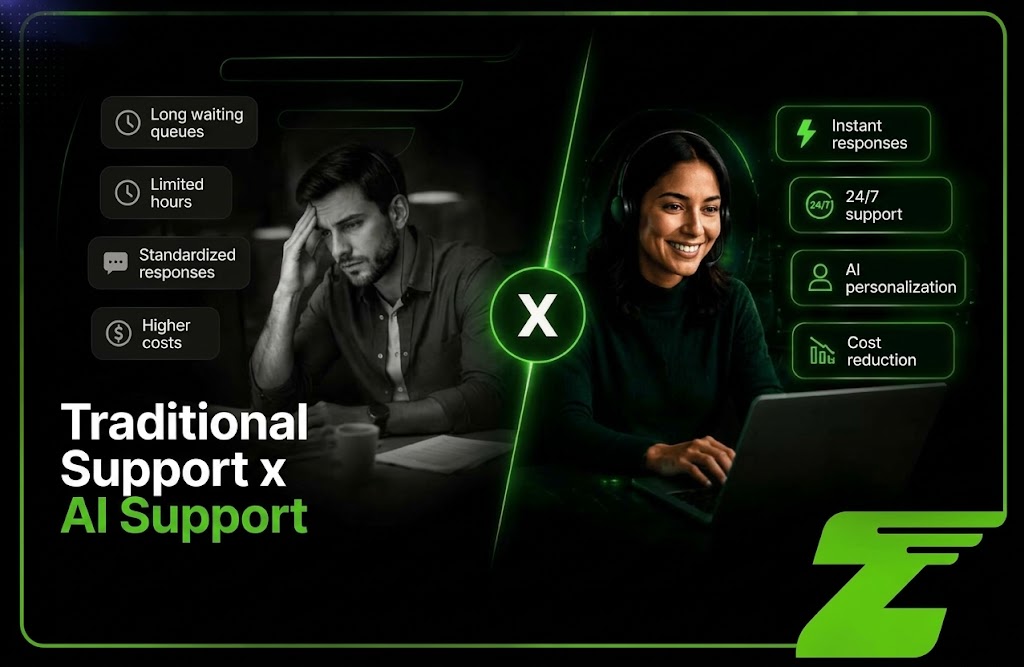
WhatsApp plays an important role in the relationship between consumers and businesses. Recent research shows that people frequently use the platform to ask questions, seek support, and interact with brands.
For SMB and mid-market retailers, this raises an important question: how much of customer service should remain manual, and how much can be automated with AI?
The answer is not to replace the entire team, but to understand where automation can reduce queues, organize demand, and expand capacity without compromising the customer experience.
In this guide, you will see how integrating AI into WhatsApp differs from traditional retail customer service by looking at speed, scale, costs, and the types of requests where each approach works best.
You will also see how Z-API can work as an integration layer between WhatsApp, business systems, and AI applications through APIs and webhooks.
The retail landscape in 2026: speed matters
In retail, slow customer service can increase friction when customers have questions about products, orders, or purchase intent.
Response time
In fully human-operated workflows, response time depends on queue size and team availability.
With automation, the workflow can start as soon as the application receives the message through a webhook, reducing the time to first response.
This does not mean responses are guaranteed within milliseconds. Latency depends on the AI model, infrastructure, integrations, and connection status.
Operational capacity
A human team has natural limits in terms of working hours and the number of simultaneous conversations it can handle.
Automation can absorb recurring questions, lookups, and triage steps, allowing people to focus on negotiations, complaints, and exceptions.
The financial benefit should be calculated by considering staff, AI, CRM, infrastructure, and messaging costs, not just the cost of the API.
Conversion
WhatsApp and conversational commerce can generate strong results, but there is no universal conversion rate that can be attributed to AI.
Omnichat, for example, promotes a case study in which Timberland achieved a seven-times higher conversion rate through a specific omnichannel commerce strategy.
This is a specific case and should not be used as a general retail benchmark for 2026.
Instead, compare automation against your own operational baseline: conversion rate, response time, abandonment, and cost per interaction.
AI-powered customer service vs. traditional customer service
| Criterion | Traditional customer service | AI-powered customer service |
|---|---|---|
| Scale | Depends on team capacity | Can absorb higher volume through automation |
| First response | Depends on the queue | Can start automatically |
| Costs | Staff, tools, and management | AI, systems, messaging, and supervision |
| Availability | Tied to team working hours | Can operate outside business hours |
| Consistency | Varies between agents | Follows instructions but still requires monitoring |
| Knowledge | Agent experience and system access | Can query RAG and integrated tools |
| Exceptions | Strong human judgment | Should escalate when context or authorization is insufficient |
| Proactive actions | Depend on processes and staff | Can be triggered by events and rules |
Z-API currently operates on a monthly per-instance pricing model and states that the Ultimate plan has no platform-imposed message limit, which can make this layer easier to budget.
Customer service automation: from recurring questions to resolution
In retail, repetitive questions can consume a significant share of customer service capacity.
With AI and integrations, requests such as order status, payment slip reissuance, or exchange requests can be partially automated. When the customer sends a message, a Z-API webhook notifies the application.
From there, the system can query the ERP, e-commerce platform, or financial system and use the Z-API API to return the information through WhatsApp.
The more sensitive or exceptional the request, the greater the need for validation rules or human support.
Sales through WhatsApp: follow-up and recommendations
When integrated with a CRM, automation can run follow-up cadences, recover context, and identify cross-sell opportunities based on available data.
For example, a customer who bought a specific product may receive a complementary recommendation when it makes sense based on their profile and purchase history.
The benefit comes from reducing missed follow-ups and standardizing processes, not from guaranteeing a specific repurchase rate.
Consumer behavior on WhatsApp
WhatsApp is deeply embedded in the digital habits of Brazilians.
In a 2025 survey, 97% of respondents said they used the app daily, 69% considered it a great channel for talking to companies, and 75% had already purchased a service through the platform.
The convenience of conversation
For certain customer journeys, allowing people to ask questions or request products through WhatsApp can reduce the number of steps compared with forms and other workflows.
A message such as:
“I want a blue T-shirt in size L.”
can trigger a workflow in which AI interprets the request, checks catalog and inventory data through integrated systems, and uses Z-API to continue the conversation.
Context without trying to imitate people
A well-configured AI can maintain the brand’s tone of voice, use authorized customer information, and adapt responses to the context of the conversation.
That does not make the AI “more human.”
The benefit lies in providing consistency, context, and speed, while situations involving negotiation, sensitivity, or judgment can still be handed off to a person.
Humanization, therefore, comes less from making AI appear human and more from preventing technology from creating friction in the customer journey.
You may also want to learn how to use WhatsApp webhooks to build real-time automations with Z-API.
Why use Z-API for AI-powered customer service in retail?
To integrate AI with WhatsApp, retailers need to connect the channel to the systems responsible for sales, customer service, inventory, and customer relationships.
Z-API operates as this communication layer through a REST API, webhooks, and queue capabilities.
Preparing for demand spikes
Promotional periods can quickly increase interaction volume.
That is why the operation should monitor queues, webhooks, errors, and the capacity of integrated systems.
Z-API provides a queue to organize messages sent through the API and webhooks to monitor message receipt, status updates, and disconnections.
These features help create a more observable operation, but they do not replace load testing and capacity planning for the rest of the architecture.
Cost predictability
Z-API currently uses a monthly per-instance subscription model and states that it does not apply its own per-message charge on the Ultimate plan.
For retailers with high interaction volumes, this model can make the cost of the messaging layer easier to forecast.
However, the total cost of automation also includes AI, cloud infrastructure, CRM, and other systems.
Proxy as a network resource
Partners can configure a proxy per instance when there is a specific routing requirement.
This feature should not be treated as a guarantee of stability, delivery priority, or protection against account restrictions.
Z-API documentation makes it clear that IP and ASN are not the main factors associated with account blocks.
AI use cases in retail
Lead qualification
When a lead starts a conversation, automation can collect information such as their needs, the product they are looking for, and urgency.
With access to the CRM and commercial rules, AI can classify the opportunity and route priority cases to a salesperson together with the conversation context.
Abandoned-cart recovery
The e-commerce system can identify an incomplete checkout and trigger an automation to resume the conversation through WhatsApp.
For example:
“Hi! I noticed your purchase wasn’t completed. Do you have any questions about the product or delivery?”
When discounts are part of the strategy, they should follow previously defined commercial rules.
It is also important to respect communication preferences and provide a way to stop receiving further messages, a practice also recommended by Z-API.
Post-purchase and loyalty
After a delivery, automation can request a review or start a satisfaction survey.
Low ratings can trigger a handoff to human support, while positive responses can feed other relationship workflows.
Repurchase recommendations can also use purchase history and catalog data, as long as they make sense for that customer.
Read next: How to build an AI-powered WhatsApp chatbot with n8n + Z-API + ChatGPT.
How to implement AI on WhatsApp in retail
Implementation can be organized into five steps:
- WhatsApp connection: configure an instance in Z-API.
- AI model: choose a model that fits the conversation type, available tools, and operational costs.
- System integration: connect CRM, ERP, inventory, and e-commerce systems to the application.
- Knowledge base: use RAG to make catalog information, policies, and up-to-date content available.
- Monitoring: track conversations, errors, handoffs, costs, and commercial outcomes.
Z-API webhooks notify your application about WhatsApp interactions. The logic responsible for querying CRM, inventory, and other systems remains part of your own architecture.
Personalization in WhatsApp sales
AI can help use context and available data to present more relevant options without relying exclusively on the salesperson’s memory.
Data-driven personalization
When integrated with the CRM, the application can retrieve preferences, previous purchases, and other authorized information.
AI can use this data to contextualize the conversation and recommend products when there is a relevant relationship.
The goal is not to create “perfect memory,” but to make better use of information the company already has.
Fewer options, more context
Instead of presenting dozens of products, AI can select alternatives based on the customer’s stated needs.
Z-API also supports carousels with images, text, and buttons, which can be used to present products in a more visual format.
Technical architecture of the operation
When the customer sends a message, Z-API notifies the application through a webhook.
The orchestrator can then query the CRM, product catalog, RAG system, and other sources before generating a response.
The application then uses the Z-API API to send the message through WhatsApp.
The flow can be summarized as follows:
WhatsApp → Z-API → application/AI → business systems → Z-API → WhatsApp
Messages sent through the API enter a queue before being processed, so it is better to avoid making fixed latency promises.
Agentic AI and MCP Server
Z-API’s MCP Server allows AI applications to use selected WhatsApp operations as tools.
It currently offers 9 tools for sending text, images, and video, as well as managing groups.
To check inventory, reserve a product, or complete a purchase, the agent needs additional tools connected to the e-commerce platform, ERP, or payment system.
The architecture can work like this:
AI interprets → ERP checks inventory → e-commerce reserves product → financial system generates payment → Z-API communicates through WhatsApp
Z-API also provides a REST endpoint for sending a Pix button with a copyable payment key.
How to calculate automation ROI
The decision should be based on the actual results of the operation.
Cost per interaction
Compare costs before and after automation by considering:
staff + AI + Z-API + CRM + cloud + other tools
Automation can allow a higher volume of interactions to be processed without increasing staff at the same rate, but the actual result needs to be measured.
LTV and repurchase
Faster support, post-purchase communication, and recommendations can contribute to customer relationships and repurchase, but they do not guarantee higher LTV.
Track metrics such as repurchase rate, average order value, retention, and revenue per customer before and after implementation.
Traditional vs. AI: what to measure
| Metric | Traditional customer service | AI-powered customer service |
|---|---|---|
| Staff cost | Varies according to required capacity | Can reduce manual tasks |
| Technology | Customer service platform, CRM, and systems | Z-API, AI, CRM, and infrastructure |
| Cost per interaction | Calculated by the operation | Should be measured after automation |
| Sales recovery | Depends on the process | Can automate follow-ups |
| Average order value | Depends on strategy | Can support cross-sell and upsell |
| Margin | Depends on costs and revenue | Depends on actual efficiency gains |
The best indicator is not how much customer service was automated, but how much the operation improved conversion, cost per interaction, satisfaction, and revenue without compromising the customer experience.
See also: How to integrate a WhatsApp API with your CRM — a proven strategy.
Challenges and myths of AI in retail customer service
Some companies still associate automation with rigid experiences that fail to solve problems.
Current technology allows much more flexible models, but quality still depends on how the customer journey is designed.
“My customers prefer talking to humans”
Preference may vary depending on the type of request.
For simple queries, speed and resolution may matter more.
For negotiations, complaints, or sensitive situations, human involvement may add more value.
That is why a strong architecture combines automation for predictable requests with handoff for situations that require people.
“It is too expensive and complex to integrate”
Complexity depends on the systems involved.
Z-API provides a REST API, webhooks, and testing through Swagger and Postman, which can make integration with external applications easier.
Automation tools can also reduce the amount of code required for certain workflows, although more complex operations still require proper development and architecture.
Governance and security in conversational retail
Automating customer service requires defining which data will be used, who can access it, and which actions the AI is authorized to perform.
Data protection and LGPD
Names, addresses, and purchase history are personal data and need to be handled with appropriate security measures.
Sensitive personal data has a specific definition under Brazil’s LGPD and includes categories such as health, biometrics, racial origin, and religious or political beliefs.
Companies should apply controls such as data minimization, permissions, guardrails, and infrastructure protection.
Z-API’s Privacy Policy states that TLS is used to protect data transmitted between customers and its servers.
Proxy as a network resource
Partners can configure a proxy per instance when there is a specific routing requirement.
This feature should not be treated as protection against account blocks.
Z-API documentation notes that IP and ASN are secondary factors and that there is no strategy that is 100% effective at preventing restrictions.
What comes next for conversational retail
The combination of AI, data, and conversational channels creates opportunities for increasingly integrated customer journeys.
Visual experiences
A customer can send an image through WhatsApp, and the application can forward it to a model capable of analyzing its content.
A furniture retailer, for example, could use this architecture to identify characteristics of a room and suggest compatible products.
Z-API works as the communication layer, while visual processing and other business rules remain in the integrated systems.
Purchases and recurring orders
Another possibility is to combine purchase history, inventory, and payment systems to create repurchase journeys.
“Your last purchase of this product was 30 days ago. Would you like to order it again?”
If the customer agrees, external systems can process the order and payment while Z-API maintains communication through WhatsApp.
Z-API also supports sending a Pix button, although payment confirmation depends on the integrated payment system.
AI and traditional customer service: choose the right combination
The comparison between AI and human customer service in retail does not need to end with a single winner.
Automation can increase capacity, reduce repetitive tasks, and start customer journeys outside the team’s working hours.
People remain important for exceptions, negotiations, and situations that require judgment.
In this scenario, Z-API provides the integration layer that connects WhatsApp to customer service systems, sales platforms, CRMs, and AI applications through APIs and webhooks.
The goal is to build an operation where AI handles what can be automated and people step in where they genuinely add value.
Want to test this architecture in your retail operation?
Try Z-API and evaluate how to integrate WhatsApp, business systems, and automation into your operation. New instances can currently be tested free for two days.
FAQ: common questions about AI in retail
1. Can AI completely replace my salespeople?
That does not need to be the goal.
AI can handle triage, lookups, recommendations, and other repetitive tasks, while salespeople remain responsible for situations involving negotiation, commercial expertise, or judgment.
2. Can Z-API be integrated with my e-commerce platform?
Z-API provides a REST API and webhooks and is presented by the platform itself as compatible with integrations involving e-commerce systems, CRMs, ERPs, SaaS platforms, and custom systems.
The specific implementation depends on the APIs and integration options offered by the retailer’s systems.
3. What is the risk of account restrictions when automating WhatsApp?
There is no zero-risk scenario.
According to Z-API’s own documentation, account blocks are multifactorial.
Among the most relevant factors are the number of different recipients and the content or pattern of messages. Number history, IP/ASN, and connection method may also have an influence.
That is why you should avoid unwanted messages, volumes that are inconsistent with the account’s history, and patterns that may be interpreted as spam.
4. Does Z-API charge per message?
Currently, Z-API charges a monthly fee per instance and does not apply an additional per-message charge, rather than billing separately for each send.